Identity, Gender Identity and the Self
Identity, loosely, is the set of characteristics, beliefs, and preferences that comprise a person. Most aspects of a person’s identity are mutable, meaning that one can change them. Examples would be the flavors of ice cream you like or the sports teams you follow. However, a few are immutable and can’t be changed. One such immutable aspect of oneself is something called gender identity.
Gender identity is the gender that one internally aligns with. A person’s gender identity exists independently of any other facet of their existence. It does not matter if a person was raised a certain way, is tall or short, has big feet or small, is hairy or not, likes woodworking or sewing. Gender identity does not change no matter what one is or does.
Gender is a classification system used to sort people into categories. Each category has a distinct set of expected traits, roles, and forms of self-presentation. Gender specifiers such as “man” and “woman” can be described differently across cultures and historical periods.
A person’s gender identity need not be binary, meaning that it aligns with one of the two traditional specifiers (“man” or “woman”). Nonbinary gender identities exist whereby one will align with both “man” and “woman”, no gender at all, or genders different from “man” and “woman” (sometimes in combination with “man”, “woman”, or both)
Societies typically raise children as the gender matching their sex assigned at birth. Those assigned “male” at birth (AMAB) are typically raised as “men” and those assigned “female” at birth (AFAB) are typically raised as “women”. However, a person’s gender identity does not always match their sex assigned at birth. A person who identifies as having a gender identity different from their sex at birth is considered transgender (or trans). A person who does not identify as trans is commonly called cisgender or cis for short.
A person who is AMAB who identifies as a woman is called a “trans woman” (with the space). A person who is AFAB who identifies as a man is called “trans man” (with the space). A person who identifies in any other way is said to identify as nonbinary.
Bioessentialism
A person’s assigned sex at birth in no way determines their gender identity. The idea that somehow sex (or other biological factors) are determinant in gender identity is called bioessentialism.
If there is a biological explanation for gender identity, it is so complex and requires so many variables that it would be practically useless as a determining framework. For example, there are some studies that show that certain brain patterns are associated with those who identify as trans, but distilling this data down into “this pattern means trans and this one doesn’t” is virtually impossible.
The Golden Rule (Or How To Be Trans)
As there are no external tests for gender identity, the only objective truth we have about it is that it is up to each person to determine their own gender identity. This leads to what I call The Golden Rule:
All that is required for someone to be trans is for them to identify that way. Nothing else is required.
The concept is so simple that it can seem deceiving. Something so major and life-defining shouldn’t come so easily and without requirements. What if this is a trap? What if this is something totally phony? While it may seem that way, it isn’t phony because cis people do not say to themselves “I identify as trans.” They will read this guide and none of it will resonate with them; in fact they are unlikely to read it at all because they have no reason to suspect it will.
The reality of identifying as trans is that it is very difficult for many people to come to the conclusion that they do identify that way. This guide was written with the goal of unentangling all the reasons someone might think they are or are not trans, but ultimately it is up to each person to make the determination for themselves.
We will come back to The Golden Rule again and again in this book
The Self
There are different perspectives upon the self that will be used in this book.
- The physical self - your body and social presence as they physically exist right now.
- The conscious self - this is the self you are aware of.
- The actual (or “true”) self - this is the self that matches your true gender identity.
Dissociation
A fully dissociated state is one in which the conscious self is totally unaware of something. In this text the word dissociation is treated as a quantifiable value of how unaware someone is of some aspect of their physical or actual self. [10, 11]
Repression and suppression increase dissociation. Repression is when we unconsciously dissociate and suppression is when we consciously do it. One may also practice avoidance, which is avoiding triggers that break dissociation. [9]
In terms of gender identity, some people are fully aware that they are trans from the point of their earliest memories. Others are not aware for what could be a variety of reasons and may remain unaware for decades. These people are said to be dissociated from their gender identity until they experience what this book calls their revelation event.
The revelation event is often called the egg-cracking moment, because, using the egg analogy, that is the moment the true self emerges from its shell.
The revelation event is the moment that the full dissociation between a person’s conscious self and their gender identity is broken and they are exposed to who they really are.
In this book, the words true gender identity refer to the gender identity one consciously sees after their revelation event in absence of dissociation. At the point of the revelation event a person may only see some of their true gender identity, more may be revealed later during the experimentation and exploration process.
Once the revelation event happens and the dissociation between one’s conscious self and true gender identity is broken, it cannot be fully restored. While a person may dissociate from their actual self in order to try to “unsee” what they saw, the reality is that this does not work.
In this sense, we say that a person’s revelation event is akin to them coming out of a dark cave and seeing the light for the first time. They can go back in the cave and try to blind themselves to the light, but they cannot forget what they saw. This is such that when they’re in the dark, it nags them because the light is preferable to the darkness.
The Dissociation Spectrum

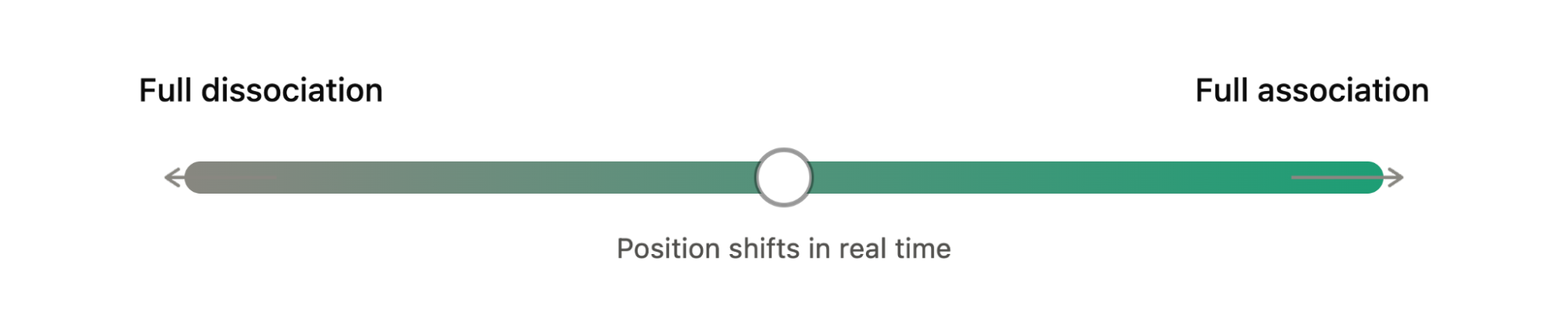
Nonetheless, it is common for a person to try to go back in the cave, or dissociate, at various points after their revelation event or at any time if they did not have a revelation event. This is why dissociation is treated as a fluid spectrum with two poles:
- Full association: conscious self fully sees true gender identity
- Full dissociation: conscious self is completely blind to true gender identity
A person’s place on the spectrum can change in real time based upon how much a person represses, suppresses, or embraces their true gender identity.
The poles are not achievable states. Full dissociation is not possible once a person has had their revelation event. Full association is not knowable because this pole can move as one discovers more about their true gender identity and a person can’t be sure of how much dissociation they are really experiencing at a given moment.