Obstacles
Obstacles are conditions that stop you from thinking you can physically realize your true gender identity. In some cases, one uses their obstacles to suppress themselves in order to enter a dissociation cycle, in other cases they just make a person miserable.
Obstacles are not a choice
One doesn’t make up or imagine obstacles, they are discovered during the experimentation/research one does during questioning. Sometimes, when one encounters an obstacle their first response is panic or depression because it feels like they can’t be themselves.
Obstacles can cause dissociation
There have been many occasions where I have seen where a person who experiences dysphoria feels like they cannot address their obstacles, leading them to repress themselves. Think of this as being unable to look at oneself in the mirror without experiencing disgust, feeling powerless to do anything about it, and so unwittingly avoiding the mirror. This process allows one to stop experiencing dysphoria (temporarily), with the side effect that they will no longer experience gender identity alignment because they cannot see themselves in the mirror as their true gender identity either. When a person does this, even if they identify as trans, they push themselves towards dissociation.
The result of continual repression in this manner is enough dissociation that a person inevitably begins to think they aren’t trans and/or has fuel to reject themselves. This is because they no longer routinely feel dysphoria or gender identity alignment and so they think they’re no longer trans. However, they did not magically change their gender identity, they’ve just unwittingly dissociated from themselves
I call dissociation caused by obstacles the dysphoria trap. It’s a trap because the person experiencing it is often attempting to address their dysphoria to the best of their capability but finds themselves unable to overcome it. A person experiencing a dysphoria trap:
- Should be unblocked (see below)
- Should do activities that cause gender identity alignment or remind themselves of the outcome of those activities
Ultimately, the resolution of a dysphoria trap involves a person once again seeing themselves in the mirror and experiencing gender identity alignment. Failure to resolve a dysphoria trap can cause one to reject themselves, and ultimately cause a lot of misery for that person.
Unblocking
The goal is to remove obstacles wherever possible to help people avoid dissociation and to lead them to happiness as their true selves. Unblocking involves:
- Pointing out solutions to an obstacle
- Pointing out how other people live happily despite an obstacle
This guide makes an attempt to address as many obstacles as possible. Those that apply to everyone are in this chapter. You’ll find transmasculine-specific obstacles in Appendix A and transfeminine-specific obstacles in Appendix B
Index of Obstacles and Unblocking Strategies
Family/friends won’t support me
This is one of the biggest obstacles and one of the reasons so many people stay closeted, unfortunately. To help figure out what to do, use the flow chart below.
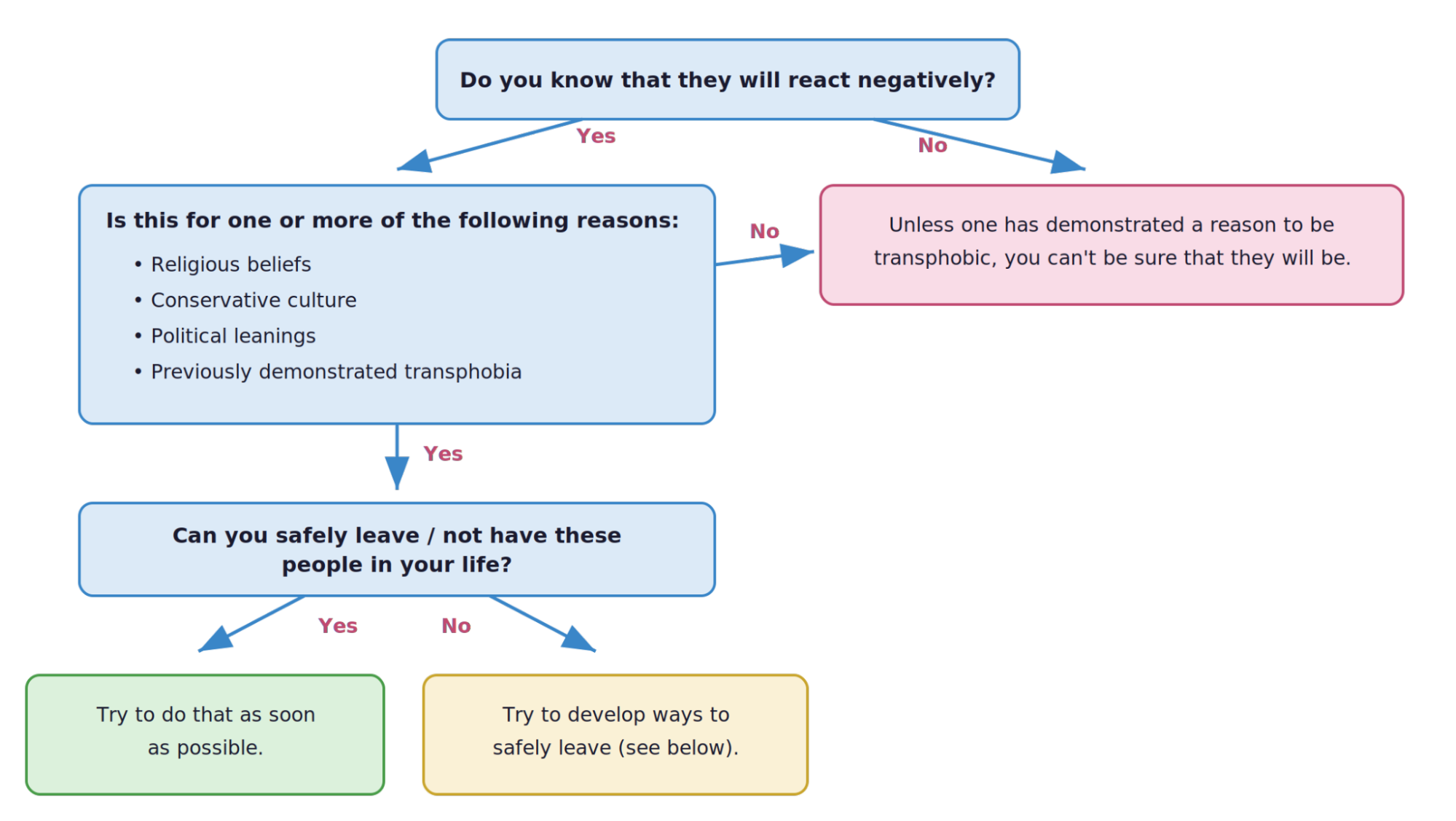
If you ended up at the pink box in the flow chart (unless one has demonstrated a reason to be transphobic, you can’t be sure that they will be) then the best approach is to assume it could go either way. However, there are some flags that it might go better or worse than you expect:
Green Flags | Red Flags |
|---|---|
|
|
If you landed on the green box (leave as soon as possible) or yellow box (try to develop ways to leave as soon as possible), then this usually means that your only option is to leave your environment.
First, I’m sorry that you’re in this situation, we need to make a better world where being trans is more accepted.
Leaving may seem untenable to certain people, especially those in cultures where family or friends have significant importance. I see a lot of posts on Reddit from people who are in conservative cultures that desperately want to leave their environment but really feel like they can’t, so they stay stuck in the dissociation cycle. If your family or friends are significantly important enough that you’re willing to suffer then you’re going to do that regardless of what this guidebook tells you. I will only caution you to be wary of who you’re sacrificing your own happiness for. Perhaps it is worth it, but perhaps it isn’t.
If you landed on the yellow box, then you have no choice but to stay in the closet because you can’t safely leave it. I’m doubly sorry about your situation because it is absolutely the worst one to be in. My recommendations for you are:
- Identify as trans if you would, don’t attempt to reject yourself because of your situation
- Begin developing a long-term plan to safely leave your environment when it is legal to do so
- Practice methods of dissociation to give you some temporary relief from dysphoria, if needed, until you can leave. Methods of dissociation are doomed to fail, so you should look at this like taking a fever reducer that will wear off. There is more information about this in the Methods of Dissociation chapter.
Do not make the mistake of trying to align with your gender identity in small ways to help yourself cope - this will only make any dysphoria you have worse.
When you do practice methods of dissociation, you may start to experience thoughts that you aren’t trans due to the dissociation. Don’t believe those, your dysphoria will return.
Financial reasons
“I will never be able to transition because I cannot afford it.”
It is true that some aspects of transition can be very expensive. Surgeries can cost tens of thousands of dollars.
However, HRT can be cheap and many other aspects of transition are free.
In many cases, a financial obstacle is about surgery and surgery is frequently about passing (see the Passing chapter).
Age
As mentioned in the Pre-Revelation chapter, a person can discover that they are trans at any age. Some people have thoughts about being a different gender going back to childhood, others discover it in their 80s. The author is a living example of not discovering until later in life, not having found her gender identity until 43 years old. Some people will let age be an obstacle to accepting themselves, telling themselves that they are too old, but the reality is that you’re never too old to be yourself.
Sexuality
A person’s sexual orientation (straight, gay, bi, pan, demi, ace, etc…) has nothing to do with their gender identity. Sometimes, as a person explores their gender identity, they will uncover aspects of their sexuality that they did not know were there, and they might find that their sexual orientation wasn’t what they thought it was.
What if HRT/transition doesn’t work for me?
Oftentimes, because timing and extent outcomes differ for effects of HRT, some will think that it is possible that HRT could have no effects on them. I will assure you, it is almost impossible for HRT to have no effects on your body - if hormones are at the correct levels, changes will almost certainly happen. The rate at which they happen and in some cases how much they happen is variable.
I won’t pass
See the Passing chapter.
Detransitioning
“But what if I start transitioning but detransition later? Then I will have messed up my body!”
If one transitions and it relieves dysphoria, and then stops, the dysphoria comes back.
Political/Safety
This is an increasingly major obstacle for those in Western societies, where in some cases trans rights are on the decline. For those in some societies such as Russia and the Middle East, being outwardly trans continues to pose a significant safety threat.
You must judge the threat in your country and determine how to act. Regardless, even in “safe” countries there is always some risk in being outwardly trans, and you should take caution. Keep your wits about you, take self defense classes, and don’t go out alone if possible.
Some things to be aware of:
- If your country has official channels for HRT, this typically means that there is at least some acceptance of trans people
- Even in countries where it is unsafe to be outwardly trans, trans communities exist in secret. Being trans does not care what country someone is born in